
2027 edition · Information reviewed on 11 November 2026.
Editorial transparency: Playmotiv prepared this guide and is one of the companies included. This is not an independent ranking: we have not contracted or audited every provider listed and have not carried out a controlled product comparison. The purpose is to help enterprise buyers distinguish between specialist agencies, software platforms and serious-game studios. Vendor capabilities should be checked directly before purchasing.
Quick answer: which gamification company should you choose in Spain?
The best gamification partner depends on the problem you are trying to solve. An organisation looking to improve sales execution across distributors needs a different solution from one that wants a bespoke learning game or a leadership simulation. Before comparing suppliers, decide whether you need strategic design, an ongoing technology platform, a customised serious game—or a combination of these.
- Playmotiv: a candidate for business gamification, onboarding and, especially, activation of field sales, distributors and retail teams through a platform linked to business KPIs.
- Game Strategies: worth exploring for corporate training through educational video games, simulations, role-play and practical skills development.
- Cookie Box: consultancy and experiential learning centred on storytelling, scenarios and decisions for culture, compliance and employee development.
- Divertifica: a provider of bespoke gamification projects, educational games, workshops and interactive experiences.
- Novelingo: specialises in digital learning, narrative-driven serious games and tailored interactive content.
- Ikasplay: develops gamified training content and simulations designed around a company’s learning needs.
- Atrivity: focuses on knowledge challenges and readiness for field sales teams and distribution partners.
The list is not ordered from best to worst. The companies are presented as alternatives with different specialisms, not necessarily as direct substitutes for the same budget or project.
Gamification companies in Spain: at-a-glance comparison
| Company | Type of offering | Best starting point for evaluation |
|---|---|---|
| Playmotiv | Corporate gamification agency and proprietary platform | Sales, distribution channels, training and onboarding |
| Game Strategies | Digital learning platform and catalogue of training games | Simulations, skills development and role-play |
| Cookie Box | Gamification consultancy and serious games | Culture, decision-making, compliance and change |
| Divertifica | Agency and bespoke game development | Custom interactive and educational experiences |
| Novelingo | Serious-game and digital-learning studio | Narrative learning and tailored e-learning |
| Ikasplay | Bespoke gamified learning content | Training content, simulations and learning experiences |
| Atrivity | Knowledge and gamification platform | Sales-channel readiness and product knowledge |
How we selected these companies
We included providers with identifiable activity in the Spanish market and publicly described services related to enterprise gamification, digital training or serious games. For each one, we outline its apparent area of specialisation and the questions a buyer should ask. We did not assign numerical scores because the products have not been tested under common criteria.
Company size, years in business or a paid position in an online directory are not reliable measures of suitability on their own. We focus on fit with the use case, solution model, proven experience, integrations, impact measurement, service support, design approach and overall cost. When a capability is not confirmed publicly, we treat it as a question to investigate rather than proof that the supplier lacks it.
Seven gamification providers to know
Playmotiv: strategy, proprietary technology and team activation
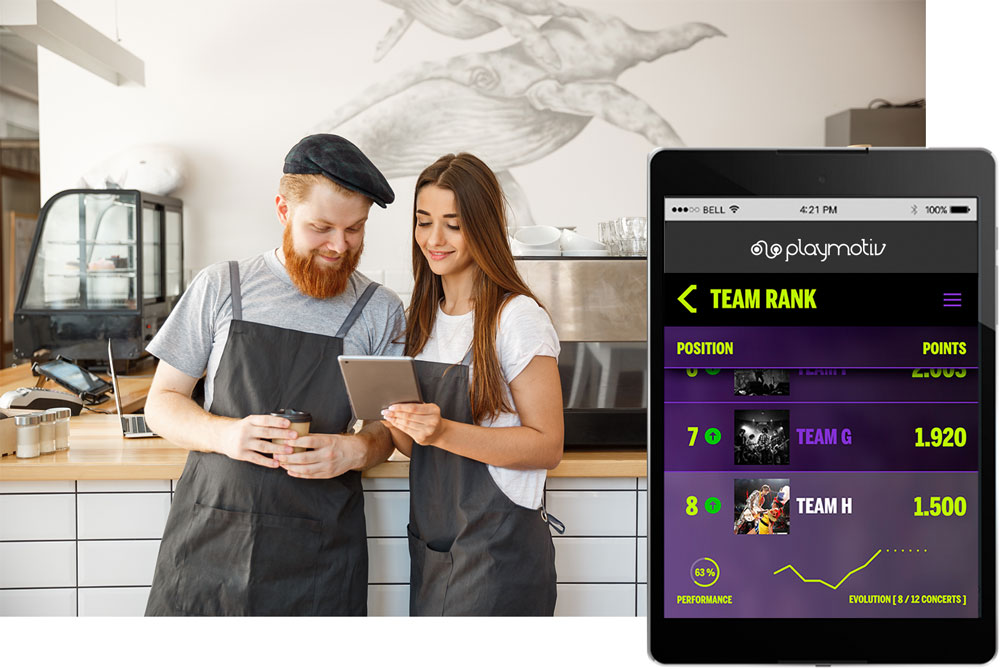
Playmotiv offers enterprise gamification programmes combining experience design, its own platform, ongoing engagement and performance reporting. Its projects span training, onboarding, sales teams, contact centres, retail and distribution channels.
It may be a fit if you want to influence measurable business behaviours, turn campaigns into missions or keep a distributed sales network engaged over time. Particularly relevant scenarios include product launches, opening new points of sale, store execution and territory-based commercial challenges.
Public evidence to examine: the Mars Iberia case study describes a three-month programme and reports results for gamified and non-gamified sales branches. Those outcomes relate to that particular customer, not a guarantee of future gains.
Questions to ask: what support is included after launch; how sales data is validated; which elements are configurable; what integrations are available; and how setup, licensing and managed services are priced. Because Playmotiv publishes this guide, readers should test our claims against a demo and customer references.
Game Strategies: training games, simulations and AI role-play
Game Strategies describes corporate learning through video games, simulations and AI-supported role-play. Its published offering covers skills such as negotiation, communication, leadership and customer service, with options for learning-management systems and international deployments.
It may be a fit if employees need a safe environment to practise skills, or the organisation wants to deliver structured gamified training to large groups. Its portfolio also includes sales-related learning experiences.
Questions to ask: which programmes are off-the-shelf versus built from scratch, what can be customised, how long deployment takes, and how learning is linked to behaviour in the workplace.
Cookie Box: experiential learning and decision-making

Cookie Box presents itself as a gamification and serious-games consultancy. Its public communications emphasise narrative-led experiences and dilemmas that help employees practise judgment in culture, ethics, safety and organisational-development scenarios.
It may be a fit if the goal is to help employees make better decisions in complex situations and receive meaningful contextual feedback, rather than simply earning points on a leaderboard.
Questions to ask: whether the intervention is entirely bespoke, how content is maintained when policies change, and which measures can show that employees apply what they learned.
Divertifica: bespoke games and gamification projects

Divertifica publicly describes expertise in gamification, serious games, narrative design and interactive experiences for organisations and education. Its profile includes customised games and gamified training projects.
It may be a fit if you need a distinctive story, interaction model or interface; a one-off educational intervention; or a custom experience that does not fit a standard platform.
Questions to ask: technical scope, accessibility, maintenance, ownership of deliverables and evaluation methodology. Request recent references and an up-to-date scope of work directly from the team.
Novelingo: narrative-driven serious games and e-learning

Novelingo develops digital-learning solutions, storytelling-based training and serious games. It publishes examples of interactive educational experiences and refers to its own tools for creating learning activities.
It may be a fit if existing training material needs to become a more immersive, story-led experience in which participants apply knowledge through choices and feedback.
Questions to ask: instructional-design responsibilities, LMS compatibility, future updates, source-file ownership and how learning effectiveness is measured.
Ikasplay: tailored gamified training

Ikasplay describes services in learning-content design, simulation, interactive experiences and compatibility with corporate learning-management systems.
It may be a fit if an organisation needs to digitise or gamify company-specific training, particularly where instructional quality and presentation format are as important as the game mechanics.
Questions to ask: who develops and approves learning content, which integration standards are supported and what happens when product or regulatory information changes.
Atrivity: gamifying commercial knowledge

Atrivity describes a solution for field representatives, distributors and channel partners that aims to identify and close knowledge gaps with short challenges, approved learning content and intelligent repetition.
It may be a fit if commercial teams must prepare for product launches, update messaging or practise responses to common customer objections across a distributed network.
Questions to ask: content sources and approval workflows, knowledge verification, reporting and whether learning indicators can be connected to commercial performance.
Agency, platform or serious-game studio: three different choices
A gamification agency typically provides diagnosis, strategy, experience design and operational support. A gamification platform offers configurable technology for running repeatable programmes. A serious-game studio develops game-like training experiences, often centred on simulation or learning.
These are not mutually exclusive categories: some suppliers combine two or all three. The distinction matters because a business may buy a custom game when it actually needs ongoing sales-channel activation, or purchase contest software when the real challenge is helping employees practise difficult customer conversations.
Which gamification company fits each business challenge?
Activating sales teams, distributors and in-store execution
Prioritise relevant channel experience, execution data, KPIs, segmentation and ongoing support. Ask for a demo based on cross-selling, sell-out, assortment growth or new-store acquisition. Compare Playmotiv’s sales gamification approach with other suppliers that can show how they handle that specific workflow.
Transforming onboarding and corporate training
Assess the balance of instructional design, content, simulations, feedback, mobile access and analytics. Depending on the learning objective, consider Game Strategies, Novelingo, Ikasplay, Cookie Box, Atrivity or Playmotiv’s gamified onboarding solution.
Culture, compliance and behavioural decisions
Look for realistic scenarios, measurable learning transfer, regular content updates and evidence of practical improvement. A scenario-based intervention may be more relevant than a productivity leaderboard.
Creative campaigns and one-off experiences
A bespoke studio or agency can offer greater freedom over storytelling and visual design. However, the organisation should budget for maintenance, content ownership, accessibility and the technical responsibilities that follow launch. Ask competing teams to quote against the same brief.
Eight criteria for comparing suppliers rigorously
| Criterion | What to assess | Useful question for the supplier |
|---|---|---|
| 1. Business objective | Define a KPI or observable behavioural change before reviewing demos. | What will we measure, and how will we evaluate the programme’s contribution? |
| 2. Target users | Distinguish desk-based employees, route sales reps, distributors and external partners. | How does the experience adapt to users’ roles and device access? |
| 3. Service model | Separate software subscriptions, fixed-scope projects, managed services and bespoke development. | Which tasks will your team own and which will ours need to handle? |
| 4. Integrations | Validate CRM, ERP, SSO, LMS and data flows with the technical team. | Can you demonstrate an integration comparable to our environment? |
| 5. Evidence | Ask for comparable cases, metrics and methodological limitations. | Which results are documented, and under what conditions? |
| 6. Operations | Identify who updates missions, communicates milestones and handles incidents. | Who will operate the programme after the launch? |
| 7. Security | Review GDPR, personal data, hosting locations and access controls. | What technical and contractual protections are in place? |
| 8. Total cost | Include setup, technology, change requests, support, prizes and renewals. | What is the full first-year cost and the cost of continuing? |
Five mistakes to avoid
| Mistake | Why it leads to poor decisions | How to avoid it |
|---|---|---|
| 1. Choosing the longest feature list | Ten irrelevant mechanics deliver less value than three tied to the right behaviour. | Prioritise features linked to your target KPI and demand a practical demo. |
| 2. Comparing non-equivalent prices | A software licence is not the same thing as a designed and managed programme. | Request quotations with the same scope and time horizon. |
| 3. Measuring participation only | Being active in a game does not prove business performance improved. | Define behaviour and outcome metrics alongside usage figures. |
| 4. Overlooking team managers | Programmes lose momentum when supervisors have no meaningful role. | Include manager reporting, recognition and feedback in the design. |
| 5. Forgetting the second cycle | A one-off activation and an ongoing programme require different resources. | Agree who will refresh missions, content and KPIs over time. |
Frequently asked questions
What is the best gamification agency in Spain?
There is no single answer for every organisation. Start with the project type and verify references, methodology, technology, results and operational support. For sales and distribution channels, Playmotiv is one candidate. For simulation-based training, consider Game Strategies. For decision-based learning and culture projects, Cookie Box is another alternative.
Are gamification and serious games the same thing?
No. Gamification applies game-design elements to an activity that is not itself a game—for example, sales execution, learning or onboarding. A serious game is a game created primarily for a purpose other than entertainment, such as practising a skill. They can be combined but are not interchangeable.
Do I need an agency or just a software platform?
If your organisation already has a clear strategy, experience-design resources, technical capacity and time to run the programme, a platform alone may be enough. If you need help defining KPIs, designing the experience, launching campaigns and supporting managers, consider an agency or managed-service provider.
How should I evaluate a gamification company?
Ask several suppliers to demonstrate the same scenario and quote the same scope. Request comparable references, a measurement plan, clear integration requirements and a description of who owns each responsibility after launch.
Use a checklist before choosing a gamification partner
Before selecting a partner, bring a consistent checklist covering strategy, user experience, technology, reporting, support and ongoing ownership to every supplier meeting. Our detailed agency-selection checklist is currently available in the Spanish-language resource centre; English-speaking teams can use the eight criteria above to prepare their shortlist.
Would you like to discuss a specific challenge? Request a Playmotiv demo or explore our approach to enterprise gamification.
Sources and editorial disclosure
- Playmotiv: enterprise gamification solutions
- Game Strategies: corporate profile
- Cookie Box: corporate profile
- Divertifica: public company profile
- Novelingo: serious games and learning profile
- Ikasplay: gamified training profile
- Atrivity: sales knowledge platform profile
Information last reviewed on 11 November 2026. Publisher: Playmotiv. The guide may be updated as material changes to vendors’ offers are verified. Inclusion does not imply commercial endorsement or partnership. See also the original Spanish edition.