2027 edition · Information reviewed on 11 November 2026.
Editorial disclosure: Playmotiv, one of the vendors included, prepared this comparison. Our goal is to explain our own approach while helping buyers evaluate alternative providers. This is not an independent ranking, and we have not laboratory-tested every platform. Descriptions of competing products are based on public information available at the review date. Integrations, commercial terms and feature availability must be confirmed with each supplier.
Quick answer: which sales gamification software should you choose?
There is no single best sales gamification platform for every organisation. A company with field sales representatives, one managing an external distributor network and another running an inside-sales team will need different game mechanics, performance data and integrations. The right shortlist starts with the behaviours you want to change—not the longest feature list.
- Playmotiv: worth evaluating for field sales, distributor networks, retail and impulse channels, using missions, challenges, learning, incentives and business KPI tracking.
- Spinify: focused on contests, leaderboards and recognition connected to sales activity in CRM systems.
- SalesScreen: combines sales competitions, performance visibility and coaching-oriented insights for sales leaders.
- Plecto: particularly relevant when continuously displaying KPIs, dashboards and office-screen competitions is central to the use case.
- Centrical: brings gamification together with learning, coaching and performance improvement for large frontline workforces.
- Atrivity: a candidate when the priority is building and verifying knowledge of products, sales messages and objections through short challenges.
This is a use-case-based selection, not a ranking from first to sixth. The following sections explain what to verify before scheduling a demo.
Sales gamification platforms: comparison at a glance
| Platform | Best-fit use case to evaluate | Publicly described focus | Question to ask during a demo |
|---|---|---|---|
| Playmotiv | Field sales, distributors and retail | Missions, competitions, rewards and business KPIs | How are sell-out, visits, product range and in-store execution connected to missions? |
| Spinify | CRM-based sales teams running regular contests | Leaderboards, recognition and competitions | Which CRM objects and data sources are supported by the contracted plan? |
| SalesScreen | Sales teams and managers with regular coaching | Gamification and AI-supported performance signals | Which coaching and automation features are included at each tier? |
| Plecto | Sales dashboards and visible contests | KPIs, TV displays, notifications, contests and rewards | Which plan includes competitions, a rewards store and reporting? |
| Centrical | Frontline teams, contact centres, learning and coaching | Missions, training, AI and recognition | Which learning and performance data can actually be integrated? |
| Atrivity | Product knowledge and sales readiness | Quizzes, challenges, spaced repetition and knowledge-gap analytics | How do you measure knowledge improvements and their use in real sales conversations? |
How we prepared this comparison
To make the guide useful, we distinguish publicly documented capabilities from those that require a direct product demonstration. The information was reviewed against publicly available vendor materials on 11 November 2026. We did not request personalised quotations, run like-for-like performance tests or conduct security audits of each supplier. We therefore do not award arbitrary scores or claim that a single product is the overall winner.
We recommend comparing six buying criteria: (1) the target team and its working environment; (2) KPIs and their underlying data; (3) game mechanics and user segmentation; (4) integration, security and technical support; (5) operational services; and (6) total cost and evidence of impact. An undocumented feature is not necessarily an absent feature.
Six sales gamification platforms worth comparing
1. Playmotiv: field sales, distributors and retail gamification
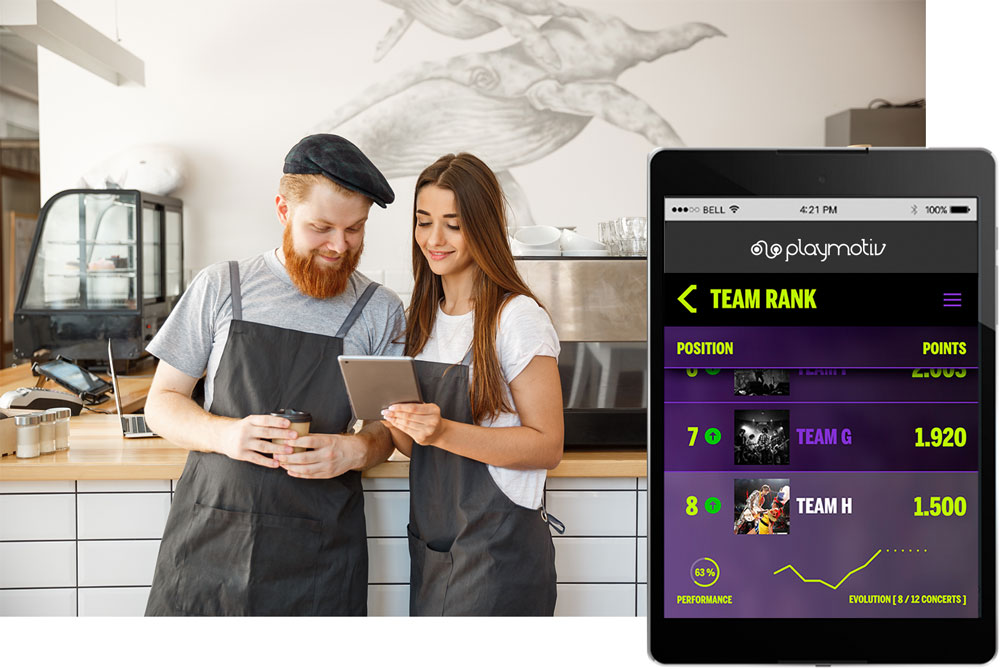
Playmotiv combines its own technology with programme design and operational support. Its approach brings together challenges, leaderboards, rewards, learning content and performance tracking. It is particularly relevant for people who spend much of their day away from a desk: route sales representatives, merchandisers, promoters, distributors and store managers.
When it is worth evaluating: impulse-channel campaign activation, opening new points of sale, product training, sell-out targets and programmes involving several territories or sales teams. Ask for a demo that follows the complete workflow—from imported sales data and mission rules to validation, rewards and manager reporting.
Published case evidence: in its Mars Iberia case study, Playmotiv reports an 11% sales increase for gamified branches during the period examined, compared with 2.8% among non-gamified branches. This is the outcome of a specific campaign, not a forecast or guarantee for another customer. Any assessment of causality should examine baseline performance, group comparability and measurement design.
What to verify: integration scope, implementation fees, subscription terms, ongoing engagement services and the administration of incentives or prizes.
2. Spinify: CRM-connected sales competitions

Spinify describes a platform connected to systems such as Salesforce, HubSpot and Microsoft Dynamics. It uses leaderboards, levels, contests and recognition to turn calls, meetings, opportunities and sales milestones into visible progress.
When to evaluate it: sales organisations whose activity is reliably recorded in a CRM and which want to recognise wins quickly, encourage friendly competition and make progress visible throughout the week.
What to verify: actual data-refresh frequency, permissions, custom CRM metrics, mobile experience, subscription tiers and onboarding support. A CRM appearing on a list of integrations does not guarantee that the specific fields your sales process relies on can be gamified.
3. SalesScreen: sales performance and coaching

SalesScreen positions gamification as a way to sustain productive sales habits. Its public materials combine competitions, missions, recognition and manager insights. The company also describes AI-related capabilities intended to flag performance changes and inform coaching decisions.
When to evaluate it: teams whose managers review sales activity frequently and need to intervene before monthly or quarterly targets are missed.
What to verify: differences between plans, the real scope of AI suggestions, supported CRM integrations and the work needed to configure relevant sales indicators. Specific functionality may depend on the agreement.
4. Plecto: visible KPIs and sales contests

Plecto emphasises real-time performance visibility through dashboards, office screens and mobile access, accompanied by notifications, achievements and competitions.
When to evaluate it: businesses that want continuous visibility of targets and results, especially where activity is already captured automatically by connected systems.
Previously published price reference: at the 11 November 2026 review date, Plecto’s public pricing showed its Medium plan starting at US$24 per tracked licence per month, billed annually with a ten-licence minimum. Competitions and a rewards store were listed under Large, starting at US$37.20 per tracked licence per month under similar conditions. These are historical, indicative prices: reconfirm current features, taxes and contractual conditions directly with the provider.
What to verify: do not assume that contest features are included in Medium just because performance dashboards are available in that plan.
5. Centrical: gamification, learning and coaching

Centrical targets large frontline organisations. Its public positioning combines challenges and recognition with microlearning, coaching, role-play and performance metrics.
When to evaluate it: organisations seeking an ongoing training and operational-improvement programme alongside sales contests, rather than a short standalone campaign.
What to verify: implementation complexity, integration with the learning ecosystem, modules included, data governance and the full cost of rollout and ongoing operation.
6. Atrivity: sales readiness through verified knowledge

Atrivity focuses on identifying and addressing knowledge gaps across field teams and sales channels through short challenges, intelligent repetition and assistants grounded in approved content.
When to evaluate it: manufacturers, pharmaceutical businesses and networks with complex product information, frequent launches or a strong need for consistent sales messaging and objection handling.
What to verify: the relationship between learning progress and observable sales outcomes, supported content sources and controls for the accuracy of AI-generated responses.
Which platform fits your organisation?
If you manage a distributor network: ask each vendor to demonstrate a realistic sell-out or in-store execution scenario, with channel-specific targets, incentives and fair territory segmentation. Include Playmotiv in the assessment; if product knowledge is the main issue, consider Atrivity as well.
If you manage an SDR or inside-sales team: compare Playmotiv, Spinify, SalesScreen and Plecto using the same sample data: qualified calls, demos, opportunities, conversion rates and closed revenue. If you want to connect contests with learning, missions and ongoing performance improvement, ask to see those workflows too. Assess how much administration each system requires from sales managers.
If you lead a contact centre with continuous training: review Centrical and SalesScreen, among other options, against service quality, efficiency, coaching and learning requirements—not just call volumes.
If your priority is sales onboarding: include Playmotiv when evaluating structured learning paths, quizzes, simulations, missions and progress tracking for new hires. Distinguish between encouraging sales behaviours and rehearsing sales skills. A staged learning experience may be more valuable than ranking new starters by call numbers.
Costs and ROI: what a per-user price does not tell you
Before comparing prices, request the full first-year cost from each provider: minimum licence commitment, setup, connectors, programme design, support, incentive administration, ongoing management and renewal terms. A low subscription can become expensive if your team must build and run every campaign. Conversely, a managed service may justify a higher initial cost if it replaces work that would otherwise fall on sales managers.
For impact measurement, establish a baseline and use comparable groups where feasible. Participation in a game is not the same as sales growth caused by that game. Monitor leading indicators such as valid store visits, product knowledge and completed missions, alongside commercial outcomes such as conversion, product assortment, sell-out, revenue and margin.
Buying checklist: seven questions to ask in the demo
- What specific behaviours can the system reinforce beyond final sales results?
- Which systems supply the data, who validates it and how often is it refreshed?
- Can we run fair competitions across territories or teams of different sizes?
- How are training, recognition and rewards handled in the user journey?
- What operational support is available after the programme goes live?
- What costs sit outside the licence and what is the contractual commitment?
- How will impact on KPIs be measured, and what assumptions would support a causal interpretation?
Frequently asked questions
What is the best sales gamification software?
It depends on the team and the business objective. For CRM-driven competitions, Spinify, SalesScreen and Plecto are options to compare. For distributed sales teams and channel activation, Playmotiv is a relevant candidate. For skills development and sales readiness, also consider Centrical and Atrivity.
How is a sales contest different from a gamification programme?
A contest typically ranks participants by a chosen metric over a defined period. A broader gamification programme can add progression, missions, learning content, user roles, collaboration, rewards and reporting. The right combination depends on the behaviour the organisation wants to improve.
Can a distributor network be gamified without using our CRM?
Potentially, yes. Reliable data may instead come from sell-out reports, ERP systems, store visits, verified actions or approved manual uploads. The provider must support that workflow and the organisation should define data validation, permissions and privacy requirements in advance.
How much does sales gamification software cost?
There is no universal price. Some suppliers publish licence fees per user while others quote projects individually. Compare the total cost of subscription, implementation, integrations, support, engagement services and prizes rather than a headline rate alone.
Want to assess a platform built for field sales and distribution?
If you need to motivate distributors, connect campaign priorities to sales activity or measure in-store behaviours, we can demonstrate how a programme works in Playmotiv. Request a demo or explore our business gamification approach.
Sources and transparency
Descriptions were reviewed against public material available in November 2026 from Playmotiv, Spinify, SalesScreen, Plecto, Centrical and Atrivity. The competitors listed have not sponsored this guide. Playmotiv is both the publisher and an interested participant in the market. Last review: 11 November 2026. See also the original Spanish edition.